

The landscape of business technology has undergone a seismic shift. As we move through 2026, companies across Northern Virginia and the greater DC area are recognizing that traditional IT approaches no longer meet the demands of modern business operations. The question is no longer whether to adopt managed IT services, but rather how quickly organizations can make the transition to stay competitive.
The numbers tell a compelling story. Businesses that have partnered with managed service providers are reporting significant improvements in operational efficiency, security posture, and cost predictability. But what’s driving this widespread migration away from traditional IT models?
The Fundamental Shift in Business Technology
The relationship between businesses and their technology infrastructure has fundamentally changed. What once served as simple tools to support operations have become the very backbone of how companies function, compete, and deliver value to customers. Every transaction, communication, and decision now flows through digital systems, making technology reliability mission-critical.
This transformation has exposed a harsh reality: the traditional model of managing IT internally was designed for a different era. Organizations find themselves at a crossroads. They can continue investing heavily in building internal IT capabilities that struggle to keep pace with change, or they can partner with specialists who make technology management their core competency. Here’s why businesses across industries are choosing the managed services path.
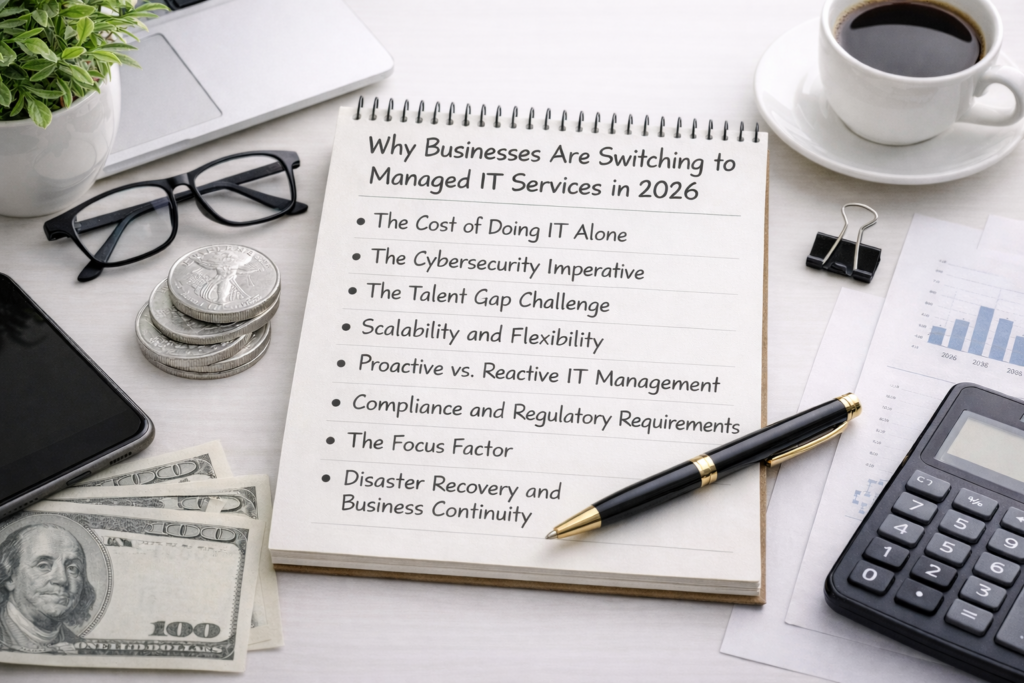
The Cost of Doing IT Alone
Running an in-house IT department has become increasingly expensive. Beyond salary costs for skilled IT professionals, businesses face expenses for ongoing training, certifications, software licenses, and infrastructure maintenance. When a critical system fails or a security breach occurs, the costs multiply exponentially. Downtime can cost thousands of dollars per hour in lost productivity and damaged reputation.
Managed IT services transform this unpredictable cost structure into a predictable monthly investment. Organizations gain access to an entire team of specialists for a fraction of what it would cost to maintain equivalent in-house expertise, allowing for better budgeting and resource allocation to core business activities.
The Cybersecurity Imperative
The threat landscape has evolved dramatically. Cybercriminals employ advanced tactics that bypass traditional security measures, with ransomware attacks, phishing schemes, and data breaches becoming daily realities for businesses of all sizes. Basic antivirus software and firewalls no longer provide adequate protection.
Managed IT providers bring enterprise-grade security tools and expertise to organizations that couldn’t otherwise afford them. With dedicated security operations centers monitoring networks around the clock, businesses gain peace of mind knowing that threats are being detected and neutralized before they can cause harm.
The Talent Gap Challenge
Finding and retaining qualified IT professionals has become increasingly difficult. The technology sector faces a persistent talent shortage, with demand far outstripping supply. Even when businesses find qualified candidates, competition drives salaries to levels that many organizations struggle to sustain.
Managed service providers solve this problem by maintaining teams of specialists across various technology domains. When your business needs expertise in cloud migration, network security, or disaster recovery, that knowledge is immediately available without the lengthy hiring process or training investment.
Scalability and Flexibility
Business needs change rapidly, but traditional IT infrastructure struggles to adapt. Scaling up requires significant capital investment, while scaling down leaves organizations with underutilized resources and sunk costs.
The managed services model offers unprecedented flexibility. As your business grows, IT capabilities expand seamlessly without major capital outlays. Need to add users, increase storage, or implement new applications? These changes happen smoothly through your service agreement, allowing technology to grow in lockstep with your business.
Proactive vs. Reactive IT Management
Traditional IT departments often operate in reactive mode, responding to problems as they arise. This break-fix approach leads to recurring issues, frustrated users, and productivity losses.
Managed IT services flip this model through continuous monitoring and preventive maintenance. Potential problems are identified and resolved before they impact operations. Automated systems track performance metrics, detect anomalies, and alert technicians to developing issues. Rather than dealing with frequent emergencies, businesses enjoy stable, reliable technology infrastructure.
Access to Enterprise-Grade Technology
Large corporations invest heavily in sophisticated technology platforms that provide competitive advantages. These enterprise-grade solutions often remained out of reach for smaller organizations due to high costs and complexity.
Managed service providers democratize access to these powerful tools. By serving multiple clients, providers can negotiate favorable licensing terms and spread implementation costs. Smaller businesses gain access to the same caliber of technology used by Fortune 500 companies, including AI-powered security tools, comprehensive backup systems, and sophisticated network management platforms.
Compliance and Regulatory Requirements
Industries face increasingly stringent regulatory requirements around data protection and privacy. Healthcare organizations must comply with HIPAA, financial services firms navigate numerous regulations, and virtually all businesses must address data privacy concerns. Non-compliance can result in severe penalties and reputational damage.
Managed IT providers maintain expertise in relevant compliance frameworks and build these requirements into their service delivery. Regular audits, documentation, and security controls become part of standard operations rather than additional burdens on your team.
The Focus Factor
Perhaps the most underappreciated benefit is the ability to refocus internal resources on core business objectives. When technology management consumes less time and attention, leadership can concentrate on strategy, innovation, and growth. Every hour spent troubleshooting network issues is time not spent on activities that directly contribute to business success.
Disaster Recovery and Business Continuity
Recent years have demonstrated the importance of robust disaster recovery planning. Whether facing natural disasters, cyberattacks, or unexpected system failures, businesses need strategies to maintain operations and recover quickly from disruptions.
Managed service providers implement comprehensive backup and disaster recovery solutions as standard practice. Regular backups, redundant systems, and tested recovery procedures ensure that businesses can weather unexpected events with minimal impact.
Local Expertise for the DMV Business Community
The unique challenges facing businesses in the Washington DC metropolitan area require IT partners who understand the local landscape. From regulatory complexities of government contracting to the competitive dynamics of the region’s diverse business ecosystem, location matters when selecting a managed service provider.
BlinkTS proudly serves businesses throughout Northern Virginia and the greater DC area, delivering responsive, reliable managed IT services to organizations of all sizes. Our service area spans the entire DMV region, including Alexandria, Annandale, Arlington, Ashburn, Bristow, Centerville, Chantilly, Fairfax, Falls Church, Gainesville, Great Falls, Herndon, Leesburg, Manassas, McLean, Reston, Springfield, Sterling, Tysons Corner, Vienna, and Washington DC.
Understanding the regional business environment allows us to anticipate challenges specific to DMV-area organizations, whether addressing compliance requirements for government contractors, supporting healthcare providers, or helping professional services firms maintain competitive advantages.
The Path Forward
As we progress through 2026, the trend toward managed IT services shows no signs of slowing. Businesses that have made the transition report higher satisfaction with their technology infrastructure, improved security posture, and better alignment between IT capabilities and business goals.
The question for business leaders is not whether managed services make sense, but how to begin the journey. For organizations in Northern Virginia and the greater DC area, the opportunity to transform IT from a cost center into a strategic advantage has never been clearer.
By partnering with experienced managed service providers, businesses gain access to expertise, technology, and support that would be impossible to maintain independently. The result is more reliable technology, better security, and the freedom to focus on what matters most: growing your business and serving your customers.